


Bloodroot Sanguinaria canadensis L
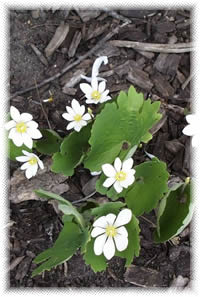
- Common Names
- Bloodroot , red puccoon blood root, pauson
- Botanical Name
- Sanguinaria canadensis L
- Family
- PAPAVERACEAE
Medicinal Uses & Benefits of Bloodroot
 How to Use|
Side Effects |
Plant & Garden|
How to Use|
Side Effects |
Plant & Garden|
- Medicinal Uses: * Cancer Prevention
* Dental/Oral Care
* Skin Care
- Properties: * Antibacterial * Cathartic * Emmenagogue * Expectorant * Poison * Skin tonic
- Parts Used: root
How to Use: Bloodroot
Do not self-treat skin cancers with
bloodroot, see a physician
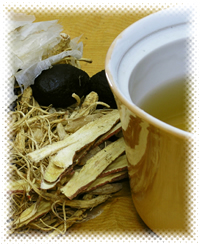
Bloodroot's name is derived from the color of the reddish roots which contain the phytochemical sanguinarine- The red juice from the root is used externally in pastes and salves to remove warts, skin tags, and some skin cancers. Eclectic doctors in the late 1800's formulated "black" salves with bloodroot, flour, water, and zinc chloride and applied it directly to tumors and other cancers. Blood root does have the unique ability to dissolve abnormal skin growths, however skin cancers should not be self-treated, it is especially important not to try to remove a blue or black skin tumor with blood root. These could be melanoma, and must be treated by a physician.
Bloodroot also is found as the main ingredient in many commercially available mouthwashes, toothpastes and cough preparations. It acts as an antiseptic that prevents bacteria from forming plaque on teeth. It is not recommended to ingest sanguinarine, brush or gargle w
Preparation Methods & Dosage :Blood root is commonly formulated in pastes from the powdered root, and made into salves for skin tag treatments. Bloodroot tinctures can also be applied topically to treat moles and skin blemishes. Internal use should be avoided.
Bloodroot Side Effects: This is a dangerous herb in the raw state root and root juice are corrosive. 1 Poisonous herb. 2
Plant Description
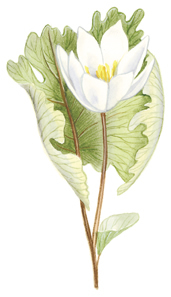
Blood root flower
- Flowers: Pure white, rarely pinkish, golden, centered, 1 to 1/2 in. across, solitary, at end of a smooth, naked scape 6 to 14 in. tall. Calyx of 2 short-lived sepals; corolla of 8 to 12 oblong petals, early falling; stamens numerous; 1 short pistil composed of 2 carpels
- Leaves: Rounded,deeply and palmately lobed, the 5 to 9 lobes often cleft.
- Rootstock: Thick, several inches long, with fibrous roots, and filled with orange-red juice.
- Flowering Season: April/May
- Preferred Habitat: Rich woods and borders; low hillsides.
- Distribution: Nova Scotia to Florida, westward to Nebraska
Snugly protected in a papery sheath enfolding a silvery-green leaf-cloak, the solitary erect bud slowly rises from its embrace, sheds its sepals, expands into an immaculate golden-centred blossom that, poppy-like, offers but a glimpse of its fleeting loveliness ere it drops its snow-white petals and is gone. But were the flowers less ephemeral, were we always certain of hitting upon the very time its colonies are starring the woodland, would it have so great a charm? Here today, if there comes a sudden burst of warm sunshine; gone tomorrow, if the spring winds rushing through the nearly leafless woods, are too rude to the fragile petals, no blossom has a more evanescent beauty, none is more lovely. After its charms have been displayed, up rises the circular leaf-cloak on its smooth reddish petiole, unrolls, and at length overtops the narrow, oblong seed-vessel. Wound the plant in any part, and there flows an orange-red juice, which old-fashioned mothers used to drop on lumps of sugar and administer when their children had coughs and colds. Netje Blanchan. Wild Flowers worth Knowing (1917)
Regional Traditions :North America *
How to Grow Bloodroot
Sanguinaria canadensis is on the United Plant Savers "At Risk" list. Wildcraft this plant responsibly and consider growing it if you have suitable garden space. Plant prefers shade garden or shade of hardwoods thrives both in deep, rich soils but will also grow on limestone outcroppings.
History and Traditions & Folklore
Bloodroot thrives in the forests of North America, and the early colonists used the red root sap for the dye pot which hung in their kitchens.
 Works Cited
- Duke,James, Ph.D. (2000). "The Green Pharmacy Herbal Handbook"
- Grieve, Maud Mrs. "A Modern Herbal" (1931)
Looking for Aroma Therapy? Visit Annies Aroma Therapy
Looking for something you can read offline? Join our mailing list and get a free copy of Methods for Using Herbs. This free handbook includes instructions on how to make basic herbal preparations at home. It covers making herbal teas, herb infused oils and balms, tinctures, and more.