


Coca, cocaine Erythroxylum coca
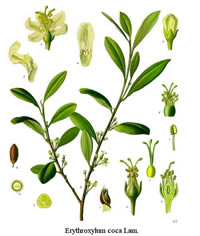
- Common Names
- Coca, cocaine , cocaine
- Botanical Name
- Erythroxylum coca
- Family
- ERYTHROXYLACEAE
Medicinal Uses & Benefits of Coca, Cocaine
Side Effects | Plant & Garden| Folklore
- Medicinal Uses: * South_American
- Properties: * Depurative * Psychedelic
- Parts Used: leaves
- Constituents: cocaine and other alkaloids
How to Use: Coca, cocaine
Coca leaves have been used as a stimulant by the indigenous people of Peru, Bolivia, and northern Argentina for centuries; it also has religious and symbolic significance.
The Coca-Cola Company buys 115 tons of coca leaf from Peru and 105 tons from Bolivia per year, which it uses as an ingredient in its Coca-Cola formula (famously a trade secret). The cocaine itself does not end up in the drink nowadays, however, and is generally sold to the pharmaceutical industry where it is used for various surgical procedures.
Preparation Methods & Dosage :
Plant Description
Coca eradication is a strategy strongly promoted by the U.S. government as part of its "War on Drugs" to eliminate the cultivation of coca, a plant whose leaves are used in the manufacture of cocaine. This strategy is being pursued in the coca-growing regions of Colombia, Peru, and Bolivia, where it is highly controversial because of its environmental and its socioeconomic impact. 1
Coca is traditionally cultivated in the lower altitudes of the eastern slopes of the Andes. Since the 1980s, the cultivation of coca has become controversial because it is used for the manufacture of the drug cocaine, which is illegal in most countries. Good samples of the dried leaves are uncurled, are of a deep green on the upper, and a grey-green on the lower surface, and have a strong tea-like odor; when chewed they produce a faint numbness in the mouth, and have a pleasant, pungent taste. Bad specimens have a camphoraceous smell and a brownish colour, and lack the pungent taste. 1
Regional Traditions :Central and South America *
History and Traditions & Folklore
The Coca-Cola Company buys 115 tons of coca leaf from Peru and 105 tons from Bolivia per year, which it uses as an ingredient in its Coca-Cola formula (famously a trade secret). The cocaine itself does not end up in the drink nowadays, however, and is generally sold to the pharmaceutical industry where it is used for various surgical procedures.Coca was also a vital part of the religious cosmology of the Andean tribes in the pre-Inca period as well as throughout the Inca Empire (Tahuantinsuyu). Coca was historically employed as an offering to the Sun, or to produce smoke at the great sacrifices; and the priests, it was believed, must chew it during the performance of religious ceremonies, otherwise the gods would not be propitiated. Coca is still held in veneration among the indigenous and mestizo peoples of Peru, Bolivia, Ecuador, Colombia and northern Argentina and Chile.
 Works Cited
Looking for Aroma Therapy? Visit Annies Aroma Therapy

Looking for something you can read offline? Join our mailing list and get a free copy of Methods for Using Herbs. This free handbook includes instructions on how to make basic herbal preparations at home. It covers making herbal teas, herb infused oils and balms, tinctures, and more.