

Vervain Verbena hastata, V. officinalis
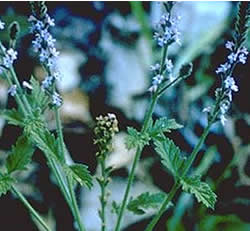
Verbena hastata
- Common Names
- Vervain , Blue Vervain, Wild Hyssop, Simpler's Joy, Herb of the cross
- Botanical Name
- Verbena hastata, V. officinalis
- Family
- VERBENACEAE
Medicinal Uses & Benefits of Vervain
 How to Use|
Side Effects |
Plant & Garden|
Folklore
How to Use|
Side Effects |
Plant & Garden|
Folklore
- Medicinal Uses: * Congestion
* Depression
* Headache/Migraine
* Herbal Teas
* Liver
* Nerve/Back Pain
* Rheumatoid_arthritis
- Properties: * Antiscrofulous * Antispasmodic * Astringent * Bitter * Digestive * emetic * Emmenagogue * Febrifuge * Midsummer * Nervine * Stomachic * Vulnerary
- Parts Used: Leaves, flowering heads
- Constituents: tannin
How to Use: Vervain
Vervain has been useful to herbal healers for many centuries of recorded history, both in the Europe (Verbena officinalis)Netje Blanchan and in North America, (V. hastata),yet there is a dearth of human studies with this herb. Vervain's healing properties are attributed primarily to its bitter and stimulating effect on the liver and other organs, as well as its relaxing effect on the nervous system. Herbalists consider vervain especially helpful when depression is related to chronic illness. 2
Vervain is useful in many diseases as a pain reliever and antirheumatic used to relive joint pain. M. Grieve recommends using it as a poultice “ vervain is good in headache , earache, neuralgia, rheumatism, etc. In this form it colors the skin a fine red, giving rise to the idea that it had the power of drawing the blood outside”.
A warm infusion of either root, leaves or flowers is helpful for colds fevers, throat and chest congestion with headache. Vervain acts as an expectorant to treat chronic bronchitis. (Dawson,Adele)
Preparation Methods & Dosage :Traditionally used as a tea, use equal amounts of vervain and sugar.
Vervain Remedies
Vervain Side Effects: avoid during pregnancy
Plant Description

- Flowers: Very small, purplish blue, in numerous slender, erect, compact spikes. Calyx 5-toothed; corolla tubular, unequally 5-lobed; 2 pairs of stamens; 1 pistil
- Stem: 3 to 7 ft. high, rough, branched above, leafy, 4-sided.
- Leaves: Opposite, stemmed, lance-shaped, saw-edged rough, lower ones lobed at base
- Fruit: Coral red, round or oval; not edible.
- Preferred Habitat:Moist meadows, roadsides, waste places.
- Flowering Season: May.
- Distribution: United States and Canada in almost every part.
Seeds below, a circle of insignificant purple-blue flowers in the centre, and buds at the top of the vervain's slender spires do not produce a striking effect, yet this common plant certainly does not lack beauty. John Burroughs, ever ready to say a kindly, appreciative word for any weed, speaks of its drooping, knotted threads, that "make a pretty etching upon the winter snow." Bees, the vervain's benefactors, are usually seen clinging to the blooming spikes, and apparently asleep on them. Borrowing the name of Simpler's Joy from its European sister, (V. officinalis), the flower has also appropriated much of the tradition and folklore centered about that plant which herb gatherers, or simplers, truly delighted to see, since none was once more salable. Netje Blanchan Wild Flowers worth Knowing(1917)
.How to Grow Vervain
Self-seeding herbaceous perennial. Native to the Eastern US and hardy to -40 degrees F. Bright blue flowers on reddish-tinted plants, in multiple, long-lasting, handsome spikes. Seeds need light to germinate. Press seed into surface soil and do not cover. Keep moist until germination. Grows well in moist garden or lawn. Vervain must be picked before flowering and dried promptly to be effective.
History and Traditions & Folklore
Vervain has been used in traditional herbal medicine by many diverse cultures from the ancient Romans and Celtic cultures to the American Indians. The name Vervain is derived from the Celtic ferfain, the plant was used by them for afflictions of the bladder and is still used today as a diuretic to treat bladder infections. Vervain was used by the American Indians to treat stomach disorders and to clear up cloudy urine. Army surgeons used it during the Revolutionary war.
Ages before Christians ascribed healing virtues to the vervain, found growing on Mount Calvary, the Druids had counted it among their sacred plants. Two of the most frequently used ingredients in witches cauldrons were vervain and rue. One is impressed with the striking similarity of many customs recorded of both. In his eighth Eclogue, Virgil refers to vervain as a charm to recover lost love. Doubtless this was the verbena, the herba sacra employed in ancient Roman sacrifices, according to Pliny. In his day the bridal wreath was of verbena, gathered by the bride herself. Netje Blanchan Wild Flowers worth Knowing(1917)
Vervain was placed around fields to prevent bad weather and was sacred to the mighty Thor, the Norse thunder god. The ancient smiths used vervain in a procedure for hardening steel, thus it comes as no surprise that this herb was mixed into love potions to make love as hot as burning iron. Claudia Muller-Ebeling, Wolf-Deieter Storl Witchcraft Medicine(1998)
 Works Cited
- Grieve, Maud . "Modern Herbal Volume 2" Harcourt, (1931) As a poultice vervain is good in headache, earache, neuralgia, rheumatism, etc. In this form it colors the skin a fine red, giving rise to the idea that it had the power of drawing the blood outside.
- Dawson, Adele. "Herbs: Partners in Life" Healing Arts Press, (2000) A warm infusion of either root, leaves or flowers is helpful for colds fevers, throat and chest congestion and headache.
- White, Linda B. M.D.. "The Herbal Drugstore" Rodale, (2003) Vervain soothes and calms the nervous system and addresses any depression hat might be present. It is also beneficial for the liver, if that organ is stressed or damaged.
- Owen N . Verbena officinalis L , British Journal of Phytotherapy, (2001;5, No. 3:114-117.): Clinically, verbena is known as a calming restorative for debilitated conditions as well as a stimulant for the liver and digestion; many cultures have considered it a heal-all, and it has been used to treat ailments of several body systems.,

Looking for Aroma Therapy? Visit Annies Aroma Therapy
Looking for something you can read offline? Join our mailing list and get a free copy of Methods for Using Herbs. This free handbook includes instructions on how to make basic herbal preparations at home. It covers making herbal teas, herb infused oils and balms, tinctures, and more.